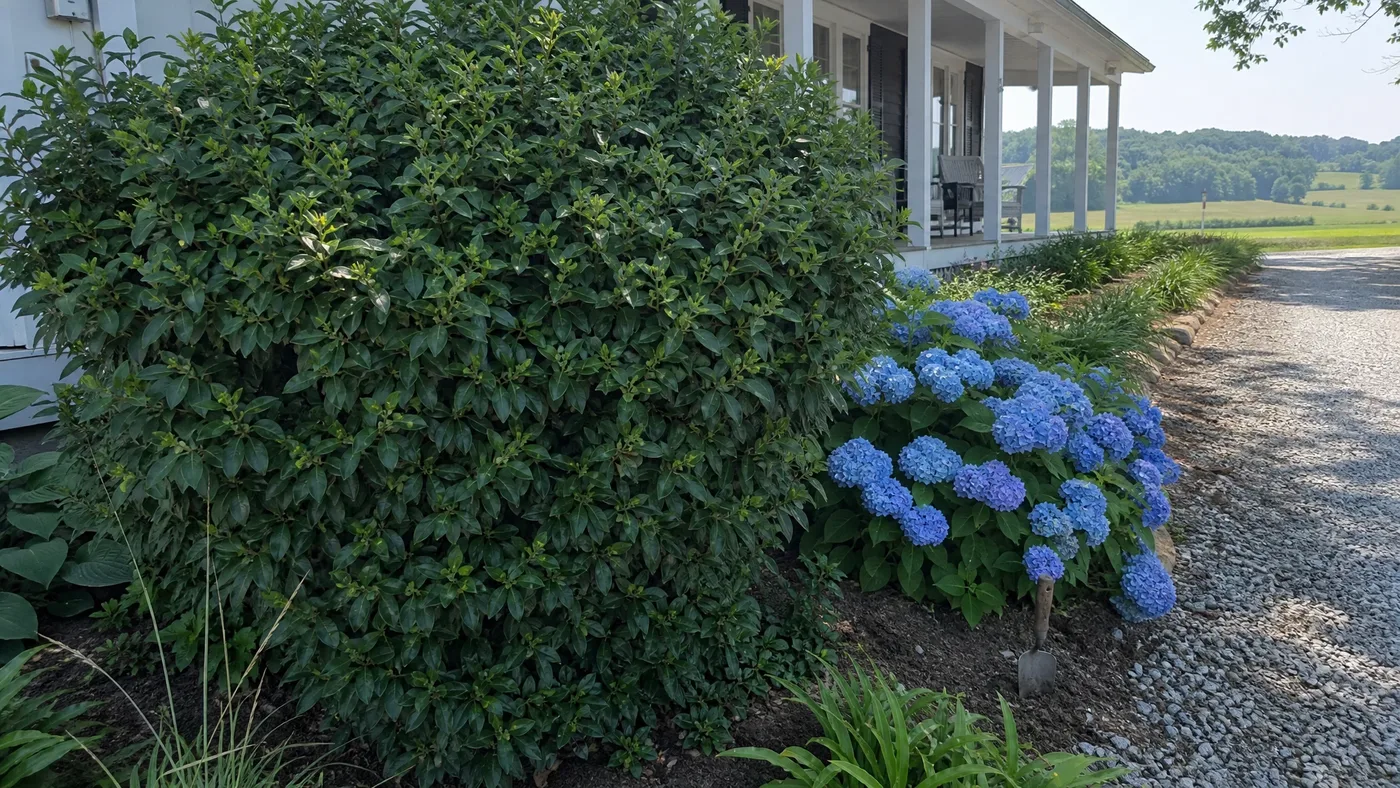
Formosa Azalea vs Hydrangea: Which Fits Your Garden Best?
You are halfway through digging in a neighbor's side yard when the question comes over the fence: "What goes here?" Two flowering shrubs come to mind before you finish your answer, and both want the same acid, humus-rich soil.
We hear this question every spring, and the honest answer rarely depends on which one photographs better. A shrub put in the wrong yard sulks for years, drops its buds or yellows by midsummer, and then the plant gets the blame.
Read on for five real yard situations: a narrow side bed, a windy corner lot, a hot deck pot, a shared border and a patch of clay. Each one is worked through for both shrubs, with a clear pick at the end.
The Narrow Side Bed Beside the Fence
A side bed is usually a shaded strip with a fence on one side and a house wall on the other. Three things decide what lives there: how much root room you really have, where the roof sheds its water, and how wide the plant gets once you stop trimming it. Measure all three before you buy anything.
Mature Width Decides It
Formosa belongs to the Southern Indica group, and the group runs 6 to 12 feet tall and 6 to 8 feet wide. That is a lot of shrub for a strip you can cross in two steps. Bigleaf hydrangea is generally 3 to 6 feet tall and wide at maturity, which is a much better match for a tight space.
You can hold an azalea to a narrow bed with pruning, but only if you cut right after the flowers fade. Shear it in fall and you remove the buds for next spring. If you plan to prune every year just to keep the shrub inside the fence line, you have picked the wrong shrub.
Eave Drip and Deep Shade
Look at the ground after a hard rain. Soil under the roof edge gets pounded and soaked in a line, while the soil against the wall can stay bone dry. Plant outside that drip line, not under it. Azalea roots are fine and shallow, and they rot in soil that stays saturated.
Shade matters too. Bigleaf hydrangea does well in dappled sun, partial shade or even deep shade. Formosa does not. Heavy shade causes weak growth and fewer flowers on azaleas, so a strip that never sees direct light will give you a leafy azalea with little bloom.
Our call: a dark, truly narrow strip goes to the hydrangea. Give Formosa the side bed only if it gets dappled light all day, sits clear of the drip line, and is wide enough for an 8 foot spread.
A Windy Corner Lot Tests Formosa Azalea
An open corner lot takes wind from two directions, and the two shrubs fail in different ways. Knowing the failure mode tells you what to look for in February, not just in July.
Evergreen leaves in winter wind. Formosa keeps its leaves through winter, so wind keeps pulling moisture out of them while frozen ground cannot send any back up. The result is brown, crisp leaf edges by late winter, which growers call winter burn. The Southern Indica group is listed for zones 6a through 9b, and the colder end of that range is where this shows up. Our winter care guide for cold climates covers the steps in detail.
Bare stems and lost buds. A bigleaf hydrangea drops its leaves, so it has nothing to burn. The risk sits in the stems. It blooms on the previous year's growth, so a winter that kills exposed stem tips takes the summer flowers with it. Its big, soft leaves also tatter and flop in summer gusts, and the multi-stemmed, rounded habit means a wind-whipped plant looks ragged for weeks.
Branch habit. Formosa is a taller, woodier shrub, up to 12 feet in its group, and it can act as the windbreak itself once established. Deer also cross open lots freely. Both shrubs are listed as susceptible to deer damage, so an exposed corner may need a fence regardless of your choice.
Our pick for the corner is Formosa, but only with some help. Put a fence, wall or hedge on the windward side, mulch the roots, and water deeply before the ground freezes. Tuck the hydrangea on the lee side of that break, never at the sharp point of the corner.
The Hot Deck Pot in Mid-July
Dark pot, south-facing deck, several scorching days in a row. This is where you find out which plant you actually bought.
Which One Sulks First
The hydrangea, nearly every time. Its large leaves lose water faster than the roots can replace it, so they wilt by midafternoon even in moist soil. NC State advises protecting bigleaf hydrangea from afternoon sun, and a deck pot rarely gets that protection. Customers usually ask us why their hydrangea collapses at 3 p.m. and perks up at night. That is heat load, not disease.
Formosa holds up better in leaf but has shallow roots that cook in a thin-walled dark pot. Its trouble shows up slowly, as leaf edges browning and bud drop the following spring. See our guide to growing Formosa in containers for the fuller picture.
Pot Size and Watering Rhythm
Choose the largest pot you can move, and pick a wide one over a tall one, since both root systems spread sideways. A light-colored or double-walled pot keeps the root zone cooler. Use an acidic, well-drained potting mix, never garden soil.
- Push a finger two knuckles into the mix each morning. Water only if it feels dry at that depth.
- In peak summer, plan on watering most days and soak until it runs from the drainage holes.
- Keep the saucer empty. Standing water turns a hot pot into a swamp.
- Our seasonal watering guide has the rhythm for the rest of the year.
Keep pets in mind on a deck. The ASPCA lists azalea as toxic to dogs, cats and horses, and hydrangea carries the same listing, so neither wins on that point.
A pot is also a temporary home. Formosa wants to be 6 feet or more, so plan on moving it to the ground in a few years. The plants we ship are already pot-grown, so repotting one into a larger container is simple.
Sharing One Bed When Formosa Azalea Blooms First
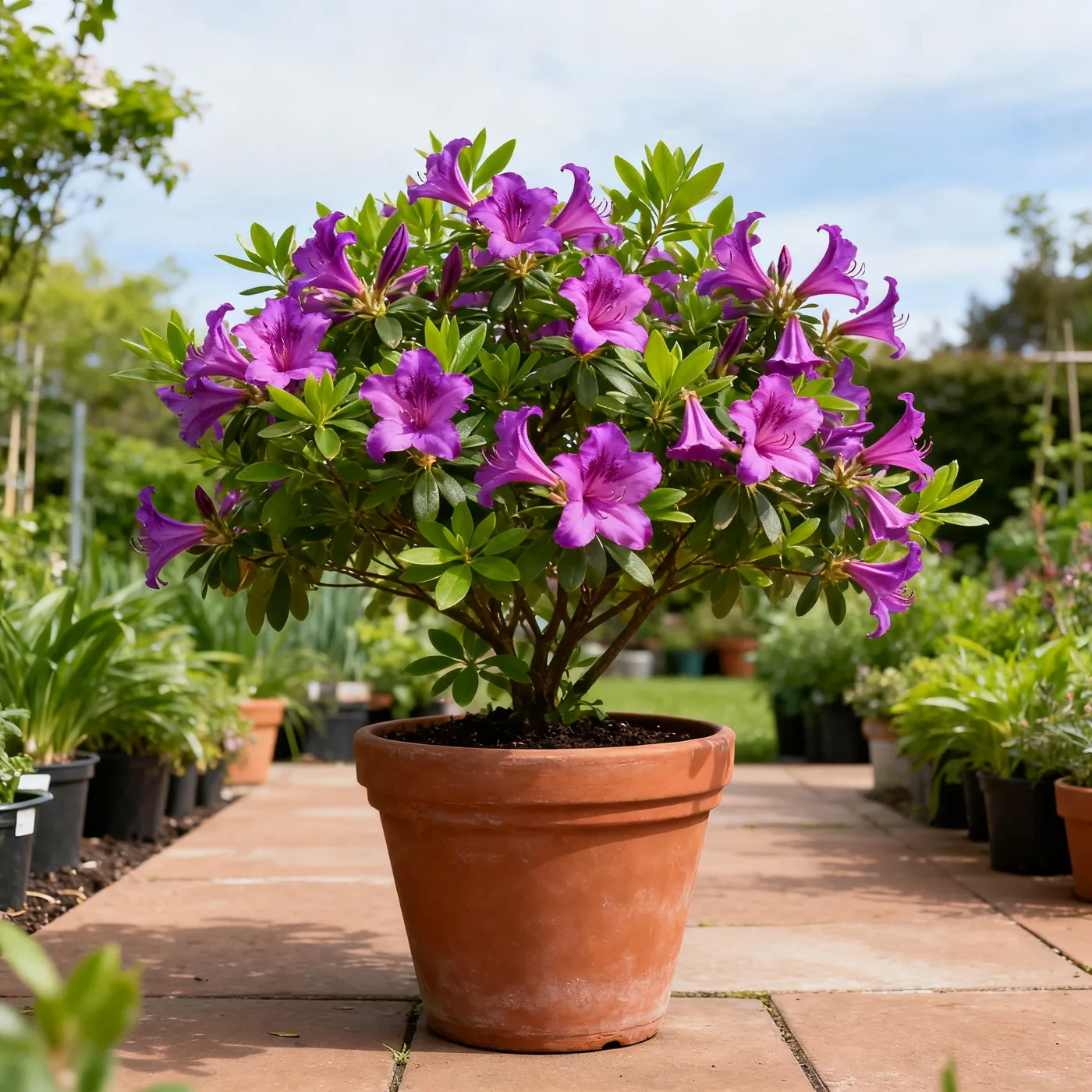
This is the pairing most people want, and it works because the bloom seasons barely overlap. Formosa flowers in late March to early April, in magenta that is hard to miss. The hydrangea, which blooms in late spring and summer, then takes over just as the azalea goes back to plain green.
Handing Off the Season
The pairing has one pruning conflict. Azalea gets cut right after flowering. Bigleaf hydrangea sets flowers on last year's growth, so a hard cut in winter or early spring removes the blooms. Leave the hydrangea alone apart from dead wood, and the two shrubs will not fight over the calendar.
Spacing, Soil and Color
Both shrubs want acid soil, and azaleas do best at pH 4.5 to 6.0. The same soil has a bonus for hydrangea: blue flowers develop in acidic soil and pink in alkaline soil. We'd rather not guess at your bed, so test the pH first.
- Space plants center to center at half of one mature width plus half of the other. With Formosa at up to 8 feet wide and hydrangea at 3 to 6 feet, that is roughly 7 feet.
- Put the azalea where it gets the dappled light and the hydrangea where it gets the afternoon shade.
- Mulch both with pine bark or leaf mold, kept off the stems.
- Choose blue hydrangeas next to magenta Formosa. Pink beside magenta clashes, and we have seen plenty of beds ruined this way.
For companions that fill the gaps, our landscape ideas and companion plants guide suggests camellias, ferns and hostas.
Clay Behind the Garage, Where Both Struggle
Heavy clay holds water, packs tight and often runs near neutral or alkaline, especially next to concrete and a foundation. Both shrubs hate that combination. Azalea roots need air, so waterlogged clay brings yellowing leaves and root rot. Hydrangea sulks more slowly and turns pink in alkaline soil, but it is no happier in a puddle.
We often see azaleas with yellow leaves and green veins in a bed beside a concrete slab, and the cause is nearly always pH, not a missing fertilizer. Lime leaching out of the concrete raises the soil pH, and the plant cannot take up iron. A cheap soil test settles it.
Fixes That Work
Do not dig a hole and fill it with good soil. Clay turns that hole into a bathtub. Plant high instead.
- Dig a test hole, fill it with water and come back the next day. If water still stands, drainage is your real problem.
- Build a mound or raised bed of acidic, organic soil, wide enough that roots can spread into it.
- Set the top of the root ball slightly above the surrounding grade.
- Mulch with pine bark and keep it off the stem.
- Test the pH again after a season. Sulfur can lower it, but follow the label rates.
Our soil guide goes through the amendments.
When to Give Up
If water still stands after a rain and the bed is flat with no room to raise it, stop. Put the shrub in a large pot and let the clay stay as lawn. We would rather you win with a container than watch an in-ground azalea decline for three summers.
Which Yard Calls for Formosa Azalea, Which for Hydrangea
Here is how each yard above sorts out, in plain terms. The table gives our pick and the main reason, and the paragraph after it covers the exceptions.
| Yard | Our pick | Main reason |
|---|---|---|
| Narrow side bed | Hydrangea | 3 to 6 feet wide, tolerates deep shade |
| Windy corner lot | Formosa, with a windbreak | Taller and woodier, no exposed bud stems |
| Hot deck pot | Formosa | Wilts less in afternoon heat |
| Shared bed | Both | Azalea in spring, hydrangea in summer |
| Heavy clay | Neither in the ground | Raised bed or large pot |
No pick here is absolute. A wide side bed with dappled light suits Formosa fine, and a sheltered deck on the north side suits a hydrangea. If you want one answer, choose Formosa for spring color on a bed with room and good drainage, and choose hydrangea for tighter, shadier spots.
Walk the Yard With a Trowel Before Buying Formosa Azalea
Take a trowel and walk the yard before you buy either shrub. Dig a small hole where you plan to plant, fill it with water and see how long it takes to drain. Check the light at 3 p.m., not at breakfast, and note how far the roof sheds water from the wall.
That ten minutes usually answers the question for you. Good drainage and dappled light point to Formosa. Deep shade and a tight space point to hydrangea. A bed that has room for both gives you magenta in April and a second show in summer.
Formosa Azalea
Nursery-grown Formosa Azalea in sizes from 1 Gallon, shipped to your door.
From $29.95
Shop Now →Magenta April blooms come from the way we raise Formosa: rows of acidic, quick-draining ground with soft, filtered light falling across them. Nothing leaves our farms unless it is a top-quality shrub we would plant at home. If your trowel test favored this azalea, come see the Formosa Azaleas we have ready for your bed.